At a time when conversations about declining reading habits have become almost routine, a Hindi fantasy novel has quietly delivered an encouraging counterargument. According to a recent announcement shared by author Kumar Pankaj on his official Instagram account, Elga Gorus crossed the milestone of more than 4,000 copies sold soon after its launch. For a two-volume fantasy novel written in Hindi, this is not merely a satisfying commercial achievement. It is also an important cultural moment. It demonstrates that readers are still willing to invest their time and money in ambitious, original storytelling when a book succeeds in offering something beyond familiar formulas. More importantly, it signals that there exists a growing readership eager to embrace large-scale fantasy, mystery, and mythological fiction in Hindi, a space that has remained comparatively unexplored for many years.
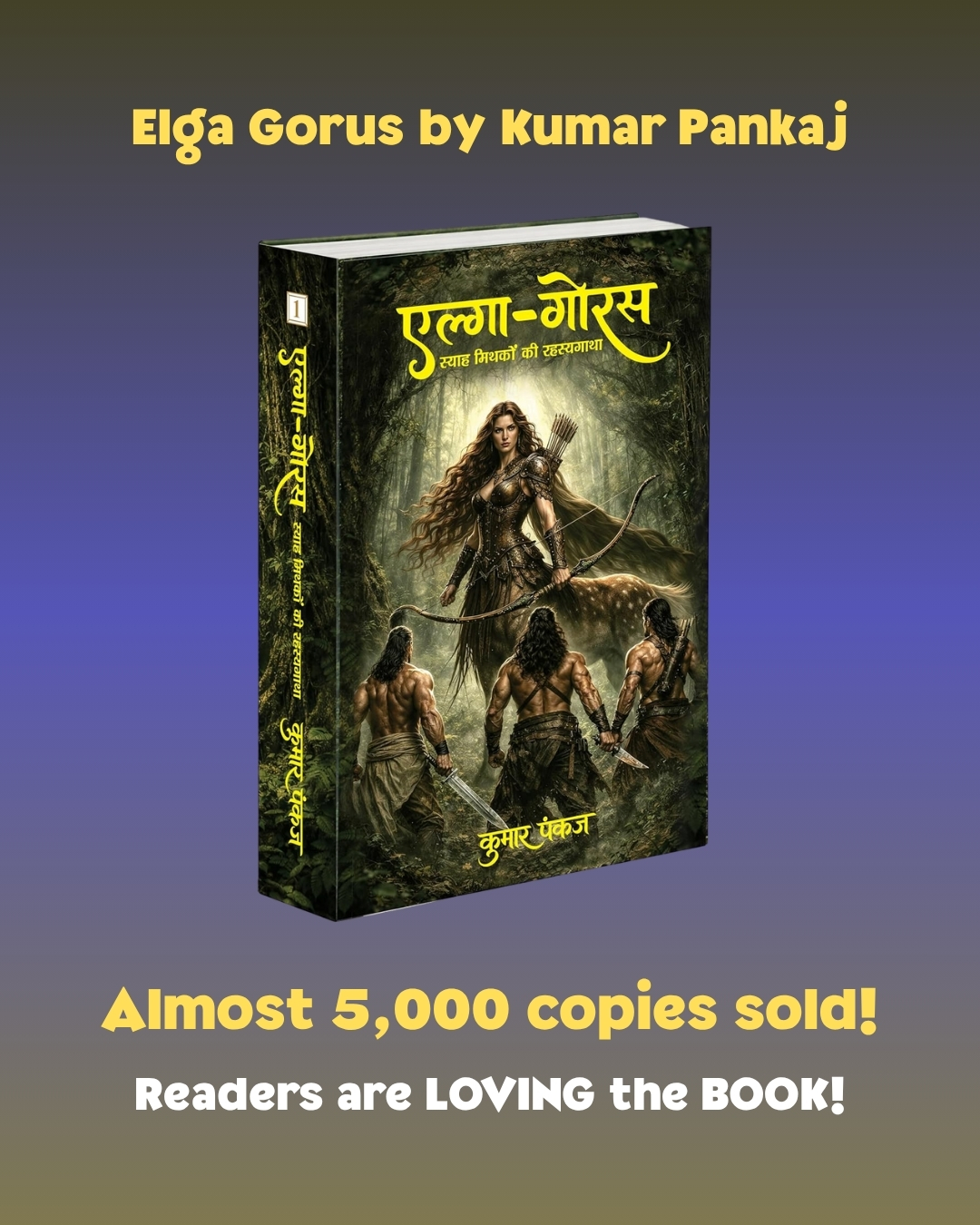
The significance of this response becomes even clearer when one considers the nature of Elga Gorus. Kumar Pankaj did not choose the easier route of writing a contemporary romance or a relationship-centred novel, genres that dominate a considerable portion of today’s commercial fiction. Instead, he spent years constructing an expansive fictional universe populated by mysterious civilisations, forgotten scripts, ancient books, extraordinary creatures, symbolic journeys, and philosophical reflections. Such a project demands enormous creative commitment, but it also carries considerable commercial risk because fantasy on this scale has rarely been attempted in modern Hindi literature. The enthusiastic response from readers therefore appears to validate not only the quality of the work but also the author’s faith that Hindi readers were ready for something far more ambitious.
Perhaps the most remarkable aspect of the novel’s journey has been the manner in which readers themselves have become its strongest ambassadors. Much of the excitement surrounding Elga Gorus has grown through personal recommendations, detailed reviews, photographs of the beautifully produced editions, discussions across social media platforms, and readers enthusiastically sharing passages that stayed with them long after they had finished reading. This kind of organic appreciation cannot easily be manufactured. It develops only when readers feel that they have encountered something genuinely distinctive. The success of Elga Gorus therefore reflects more than healthy sales. It reflects meaningful reader engagement, which is often a far stronger indicator of a book’s long-term impact than numbers alone.
One reason behind this growing admiration lies in the novel’s memorable philosophical observations. Throughout both volumes, Kumar Pankaj frequently interrupts the unfolding adventure with reflections that readers have eagerly quoted and discussed. Lines such as, “ज़िम्मेदारी कभी किसी को ‘सौंपने’ से पूरी नहीं होती, वो हमेशा किसी के ‘स्वीकारने’ से अंजाम तक पहुँचती है।” and “किसी किताब में, चाहे जो लिखा हो, पढ़ने वाला वही पढ़ता है, जो वो पढ़ना चाहता है।” have travelled well beyond the pages of the novel because they speak to everyday experience while retaining a poetic quality. Similarly, observations like “जो समझ आ गया, वो सत्य नहीं होता…” reveal that Elga Gorus is interested not merely in entertaining readers but also in encouraging reflection. It is this combination of narrative excitement and philosophical inquiry that appears to have resonated with many readers and contributed to the book’s enthusiastic reception.
What makes this achievement particularly significant is that it has not been driven merely by aggressive marketing or celebrity endorsements. Much of the novel’s popularity appears to have grown through readers themselves. Social media posts, personal recommendations, lengthy reviews, photographs of the beautifully produced volumes, and enthusiastic discussions have gradually transformed Elga Gorus into one of the most talked-about recent works of Hindi fantasy. Readers are not merely recommending a book. They are recommending an experience. That distinction matters because memorable books often create conversations that extend far beyond their pages.
One reason for this enthusiasm becomes evident the moment one begins reading the novel. Elga Gorus refuses to behave like conventional fiction. Instead of introducing readers to familiar characters and predictable settings, it opens the doors to a mysterious universe filled with forgotten civilisations, ancient scripts, enigmatic creatures, hidden histories, and quests whose significance extends beyond ordinary adventure. Kumar Pankaj trusts his readers enough to let them discover this world gradually. Rather than simplifying every mystery, he allows curiosity to become the engine of the narrative. It is perhaps this confidence that has encouraged readers to remain invested across both volumes.
Another factor behind the book’s growing popularity is its language. Despite the complexity of its imaginative universe, the novel frequently pauses to offer striking philosophical reflections that readers have enthusiastically shared online. Many of these lines possess the quality of memorable aphorisms. Consider the observation, “ज़िम्मेदारी कभी किसी को ‘सौंपने’ से पूरी नहीं होती, वो हमेशा किसी के ‘स्वीकारने’ से अंजाम तक पहुँचती है।” Such statements transcend the immediate narrative and invite readers to reflect upon their own lives. They become the kind of passages that people underline, photograph, and share, thereby extending the life of the book far beyond the reading experience itself.
Several quotations from the novel have generated similar responses because they combine philosophical insight with poetic expression. One particularly striking line reads, “किसी किताब में, चाहे जो लिखा हो, पढ़ने वाला वही पढ़ता है, जो वो पढ़ना चाहता है।” This simple yet profound observation captures something essential about literature itself. Readers have also appreciated reflections such as “लोगों की बुद्धिमानी पर हमेशा सन्देह करना, मगर उनकी मूर्खताओं पर पूरा भरोसा रखना।” The novel repeatedly surprises not only through its plot but also through these thought-provoking observations, which encourage readers to pause before continuing their journey.
Perhaps the greatest compliment that can be paid to Elga Gorus is that readers seem to remember not only its story but also its ideas. In today’s publishing environment, where many books disappear from public conversation within weeks of release, this is no small achievement. Passages like “जो समझ आ गया, वो सत्य नहीं होता। समझाया हुआ सत्य, अर्थ का घाव होता है क्योंकि भाषा, सत्य की जीभ का छाला है।” reveal an author who is interested in exploring ideas alongside imagination. Similarly, “रहस्य, ख़ुद को तब उघाड़ता है जब प्रश्न और उत्तर दोनों पिघल जाते हैं।” demonstrates the philosophical temperament that runs beneath the surface of the fantasy narrative. These reflections give the novel a second life beyond its plot, encouraging readers to revisit particular pages long after finishing the story.
The success of Elga Gorus also reflects a changing readership within Hindi literature. For years, younger readers interested in fantasy, mythology, speculative fiction, and immersive world-building often turned almost exclusively toward English-language books. Kumar Pankaj appears to have recognised that this audience existed but remained underserved. Instead of following prevailing trends, he invested his creative energies in constructing an original fantasy universe capable of competing for the imagination of contemporary readers. The enthusiastic reception suggests that this decision was both courageous and timely. Readers have responded not only to the novelty of the setting but also to the sincerity of the author’s commitment to creating an entirely new mythological landscape.
Many readers have also admired the production quality of the two volumes. The books have frequently been described as collectable objects rather than ordinary paperbacks. Their cover design, typography, printing quality, and overall presentation have contributed significantly to the reading experience. In an age increasingly dominated by digital media, beautifully produced physical books still possess the power to attract readers. Elga Gorus demonstrates that careful publishing can complement ambitious writing, creating a work that appeals both intellectually and aesthetically.
Beyond sales figures and favourable reviews lies a more meaningful achievement. Elga Gorus has generated genuine excitement about reading. Readers have posted lengthy reflections rather than brief reactions. They have discussed characters, mysteries, favourite quotations, and future possibilities. They have debated interpretations and recommended the books to friends. This level of engagement cannot be manufactured easily. It emerges only when readers feel emotionally and intellectually invested in a work. The novel has managed to cultivate precisely that kind of community, one built upon shared curiosity and admiration for imaginative storytelling.
One quotation from the novel seems especially appropriate when reflecting upon its own journey: “अस्तित्व को जिन मूर्तियों की ज़रूरत होती है, वो उन्हें वक़्त के पत्थरों के भीतर छुपा देता है और तब तक उनके उघड़ने की प्रतीक्षा करता है, जब तक एकदम सही व्यक्ति, छेनी-हथौड़ा लेकर नहीं आ जाता।” Whether intentionally or not, these words capture something about Kumar Pankaj’s own literary endeavour. Rather than pursuing familiar formulas, he chose to carve out an entirely different path, trusting that readers would eventually discover it.
Rupesh for India Latest News
Books & Literature Desk